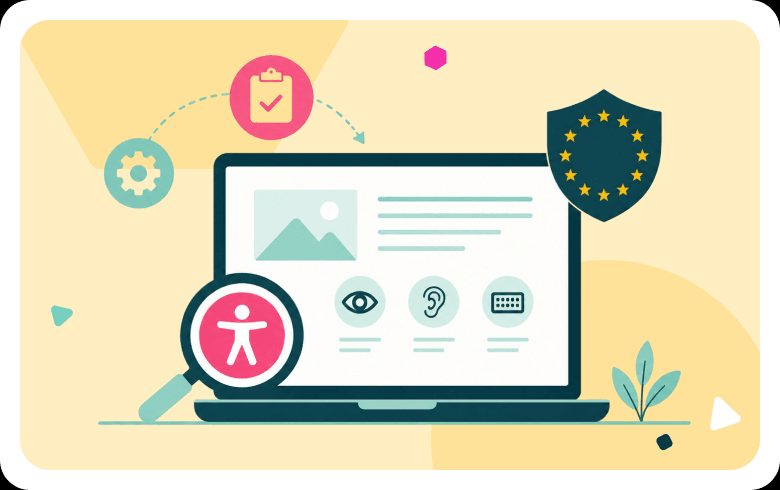
How to Conduct an EAA Website Accessibility Audit
So now you know that, when it comes to website accessibility, EAA compliance is closely linked to the WCAG 2.1 AA standards. But how do you actually check if your website is accessible?
A website accessibility audit is a process used to find barriers that may make it difficult for people with disabilities to access or use your website.
Depending on your organisation’s needs, an audit can be done using accessibility tools, manual testing, or a combination of both. Automated tools can help find many common accessibility issues quickly, while manual testing helps detect problems that require human review.
1. Define what you want to audit
Before starting your accessibility audit, decide which parts of your website you want to review.
The best approach is to audit your entire website. However, if you are just starting your accessibility journey, you may want to begin with the pages and areas that are most important for your users, such as:
Homepage and main navigation
Product or service pages
Contact pages
Forms
Checkout or payment pages
Frequently used resources
Having a clear plan helps make sure the most important parts of your website are reviewed and that accessibility barriers are not missed.
2. Run an automated accessibility scan
An automated accessibility scan is often the easiest way to understand the current accessibility status of your website.
Accessibility tools scan your pages and check them against WCAG requirements to detect accessibility issues, such as:
Missing alternative text for images
Incorrect heading structures
Colour contrast problems
Issues with forms
Missing or incorrect ARIA labels
Possible problems with keyboard navigation
Automated scans help organisations quickly identify areas that need attention and create a plan for making improvements.
For example, Nexus Inclusion uses accessibility engines to scan websites based on global accessibility standards. It detects issues related to the EAA and other accessibility requirements, while also providing clear recommendations, code snippets, and step-by-step guidance on how to fix them.
3. Perform manual accessibility testing
While automated tools are helpful, and can quickly find accessibility issues, some problems may still need to be reviewed manually.
Manual testing involves checking how easy it is for people with disabilities to navigate and use your website.
During a manual review, accessibility experts look at areas such as:
Using the website with only a keyboard
How the website works with screen readers and other assistive technologies
Whether links and buttons are clear and easy to understand
If images have useful alternative text
If forms, instructions, and error messages are easy to use
How accessible menus and interactive features are
Manual audits usually require accessibility specialists because they need experience with accessibility standards and knowledge of how different users interact with websites.
The result is a detailed report showing the accessibility barriers found, who they may affect, and how they can be fixed.
If you’d like to receive a comprehensive report from an accessibility expert, talk to us and we can explain how our manual audit work.
4. Check your results against WCAG 2.1 AA
After completing automated scans and manual testing, review the results against the WCAG 2.1 AA guidelines.
WCAG 2.1 AA provides the accessibility requirements that are used as the foundation for EN 301 549, the standard connected to the European Accessibility Act (EAA).
Nexus Inclusion lets you choose which WCAG version and conformance level to check against, depending on the accessibility regulation or standard you want to comply with.
Checking your findings against WCAG helps you understand:
What accessibility issues exist on your website
Which requirements are not being met
How these issues may affect users with disabilities
What changes need to be made
This helps your team create a clear plan for improving website accessibility.
5. Prioritise and fix accessibility issues
Finding accessibility issues is only the first step. The next step is deciding which issues should be fixed first.
Some problems may have a bigger impact on users than others. For example, an issue that prevents someone from completing a form or buying a product should usually be prioritised over a smaller content issue.
When deciding what to fix first, consider:
How many users may be affected
How important the affected page or feature is
Whether the issue prevents people from accessing information or services
How easy it is to implement a solution
A good accessibility audit should help your team understand:
What barriers exist on your website
Why they matter
How they affect users
What steps can be taken to fix them
Which improvements should happen first
Tools like Nexus Inclusion can support this process by providing clear recommendations and practical guidance to help teams make improvements.
6. Test your website again after making changes
After making improvements, run another accessibility scan and repeat manual testing where needed. This helps confirm that issues have been fixed and that new problems have not been introduced.
7. Keep monitoring accessibility over time
Websites change regularly, and new accessibility issues can appear after updates or new content is added.
Keeping your website accessible requires ongoing attention.
Regular monitoring helps organisations find new issues early and maintain a better experience for all users.
This can include:
Regular accessibility scans
Periodic manual reviews
Accessibility checks during website updates
Improvements based on user feedback
With Nexus Inclusion’s monitoring tool, organisations can schedule regular scans and receive alerts when new accessibility issues are found, allowing teams to take action quickly.