Website Accessibility: From Reactive Fixes to Proactive Delivery , Skip to main content
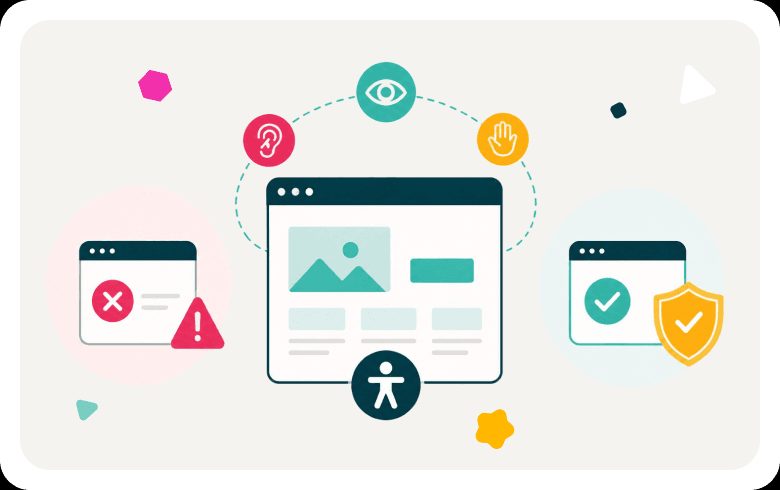
Conceptual diagram of web accessibility showing progression from inaccessible (error) to accessible (verified and secure) website, with sensory disability icons surrounding a central webpage layout.

Website accessibility is unfortunately still approached primarily as a reactive process. Many organisations follow a pattern of fixing issues at a later stage, and sometimes even repeating the same problems over and over again.

This reactive approach not only impacts people with disabilities but also creates wider challenges for organisations. Without a proper strategy for digital accessibility and inclusion, businesses often face to costly fixes, delayed releases, and sometimes regulatory risks.

A study from WebAIM, that checked the top 1 million websites worldwide, revealed that only 4% had no detectable accessibility failures.

This number is just one of the statistics that shows we still have a long journey ahead in improving web accessibility and inclusion. However, the best way to move towards this reality is by considering accessibility from the very beginning.

Why the traditional approach to website accessibility does not work?

Investing in website accessibility to discover and resolve existing issues is a valuable effort and it represents a great commitment to digital inclusion. However, this approach alone is not enough to effectively address the digital divide.

In this scenario, both users and organisations are negatively impacted.

Before a website is launched, it normally goes through several stages: discovery, design, development, QA, production, and release. These are at least six steps involved in releasing a website, but in many cases accessibility is not considered during any of them, despite the diverse audience that may be interested in their content.

This means that 1.3 billion people worldwide, according to the World Health Organization (WHO), are not even being considered while all this work is happening.

When these steps are completed and digital accessibility is ignored in all of them, there’s a high chance that all this will lead to:

  • Numerous accessibility issues
  • Non-compliance with digital accessibility regulations
  • Exclusion of 16% of a potential audience
  • Additional rework for your team
  • Costly accessibility audits & remediation
  • Regulatory fines & penalties

This is before considering what happens after a website is released. If the team is still unaware of how to make digital content accessible to people with disabilities, problems keep happening repeatedly and the business gets each day more exposed to all the issues we listed.

Shifting website accessibility left in your organisation’s strategy

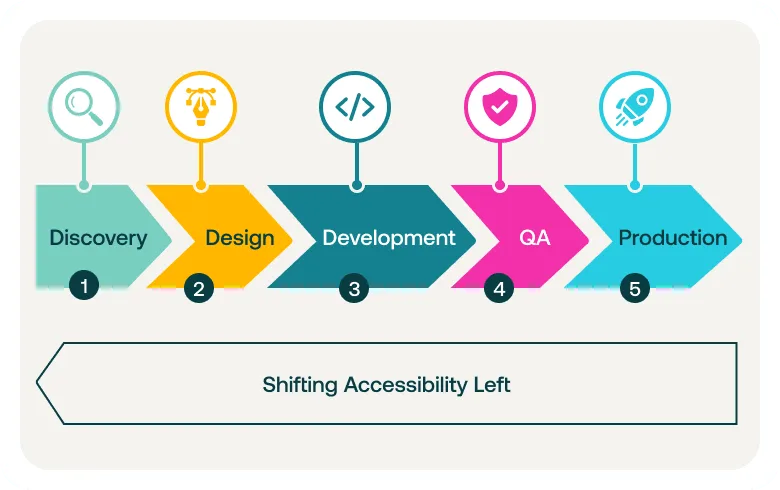
To facilitate our discussion, the workflow below represents how organisations should approach website development, with accessibility considered from the very beginning rather than addressed only after all development stages are complete.

Flowchart showing 5 phases of software development lifecycle: Discovery, Design, Development, QA, and Production, with arrow indicating 'Shifting Accessibility Left' toward earlier stages.

As we mentioned before, website accessibility is normally considered at a later stage, after all the steps represented in this image have already been completed.

This is exactly why organisations should shift accessibility left in the workflow and include digital accessibility in their strategy from the planning stage.

What does this mean in practice? It changes the current approach from questions like “how do we fix accessibility issues?” to “how do we prevent accessibility issues from happening?”.

Does that mean that you’ll be completely free from web accessibility issues forever? Of course not. However, it requires less time, reduces the effort needed from your team, lowers costs, decreases business exposure, and provides many other benefits when compared with addressing issues after they occur.

An accessibility monitoring system is capable of keeping track of your website’s accessibility and letting you instantly know when a new issue is found, giving you the chance to fix it urgently.

The Nexus Inclusion tool allows you to customise the system based on your preferences, including scan frequency, accessibility regulations, and other requirements. It also provides detailed reports that show how your website’s accessibility is improving over time.

It’s important to note that ongoing monitoring is also a requirement of most of the global accessibility regulations.

Building website accessibility into every stage of digital products

When digital accessibility is taken seriously from the planning stage, you have the opportunity to include it in every step of the development process.

Discovery: Understand user needs and accessibility requirements

Discovery is where teams learn about their users, business objectives, and technical constraints. It is also where accessibility requirements should be identified.

This includes understanding the needs of people with disabilities, reviewing legal and regulatory obligations, and making sure accessibility is included in project requirements and acceptance criteria.

The earlier accessibility requirements are defined, the less rework will be needed later.

Accessibility regulations can change depending on where your company is based, but most of them use WCAG (Web Content Accessibility Guidelines) as the technical standard.

If you want to learn more about the accessibility requirements, check out our article Understanding WCAG Web Accessibility Standards.

Design: Apply inclusive design principles

Design decisions have a significant impact on website accessibility. Navigation, colour contrast, typography, layouts, forms, and interaction patterns can either create barriers or remove them.

Applying inclusive design principles helps teams create experiences that work for a wider range of users from the beginning.

Accessible design systems, reusable components, and clear content structures make it easier to maintain accessibility consistently across the website.

Development: Build accessibility into the code

Developers should not have to keep fixing accessibility issues created during the process. Instead, accessibility should be built into the implementation itself.

Using semantic HTML, accessible components, keyboard-friendly interactions, and proper screen reader support creates a stronger accessibility foundation.

When accessibility is considered during development, many common accessibility issues can be prevented before they reach testing.

QA: Validate accessibility continuously

Quality assurance remains an essential part of website accessibility, but its role changes in a proactive approach.

QA should validate that accessibility requirements have been met through automated testing, manual testing, and assistive technology testing.

The goal is not to discover accessibility for the first time, but to confirm that accessibility has been maintained throughout the delivery process.

Production: Monitor accessibility over time

Website accessibility does not end when a website goes live. New content, product updates, and design changes can introduce new accessibility issues at any time.

This is why accessibility monitoring is essential. Continuous monitoring helps organisations detect new issues quickly, prioritise remediation, and maintain compliance with website accessibility standards and WCAG compliance requirements over time.

A proactive accessibility strategy is not about achieving a perfect website once and considering the work complete. It’s about building a process that keeps accessibility as part of your digital delivery long after launch.
Website accessibility standards provide the foundation for proactive delivery

Understanding which website accessibility standards apply to your organisation is essential when developing digital experiences and helps avoid costly rework later.

The exact accessibility law you should follow depends on where your company is located and where your users are. Here are some of them so you can understand where to start:

WCAG Compliance

When checking what regulation you should follow, you’ll notice that most of them refer to WCAG (Web Content Accessibility Guidelines) as the technical standard, which provides a set of success criteria websites should meet to achieve accessibility compliance.

Created by the World Wide Web Consortium (W3C) in 1995, it is currently at version 2.2 after updates and refinements. However, in most cases, accessibility laws expect compliance with WCAG 2.1 at Level AA.

To help organisations achieve accessibility compliance, their success criteria are based on principles, commonly known as POUR:

  • Perceivable: Information and user interface components must be presented in ways that users can perceive. 

  • Operable: Users must be able to navigate and interact with the interface. 

  • Understandable: Content and functionality should be easy to understand and use. 

  • Robust: Content should work reliably with different browsers, devices, and assistive technologies.

We highly recommend reading our article, The Importance of Accessibility & Why POUR Matters, as understanding these principles early makes future accessibility testing, auditing, and compliance efforts much more effective. 

Make website accessibility part of your organisation’s strategy

By shifting from reactive fixes to proactive delivery, organisations can reduce accessibility risks, improve digital experiences, and create processes that support long-term accessibility goals.

At Nexus Inclusion, we support organisations on this journey by providing the tools and insights needed to monitor, understand, and improve website accessibility over time.

If you are beginning your accessibility journey or looking to strengthen your existing approach, visit our All Resources page to explore helpful content and learn how to build a more effective accessibility strategy.

More Related Articles

Strengthen Your Organisation's Strategy

Explore helpful content and build a more effective accessibility strategy.